
Mark Cocker
'It takes a whole universe to make the one small black bird'
Bee Aware: my Unofficial BOOKCLUB NO 9
Solitary Bees by Ted Benton and Nick Owens, New Naturalist Library, William Collins, £35 pbk.

The superb Field Guide to the Bees of Britain and Ireland by Steven Falk and Richard Lewington (2015) is probably my most constant companion after any wildlife excursion in summer. It has decisively placed bees on the radar for many naturalists. Yet if that book teaches us anything, it is how these insect comprise an enormously complex and difficult group to identify. As an illustration, the most diverse genus, the mining bees (Andrena), includes 67 species and many of them are remarkably similar in appearance. Of necessity, the field guide, covering c275 species, focuses almost entirely on how you tell one bee from another.

Yet many of the solitary bees have fascinating lifestyles. One I love is (above) the ivy bee Colletes hederae, which was only recorded for science in 1993, arrived in Britain in 2001 and has since spread as far north as Derbyshire, where I saw it last year. Perhaps the solitary bees that many know best – from the bee-sized capes they snip out your rose leaves – are the gorgeous leafcutters (Megachile). They use these vegetative borrowings to build little leaf-tubes in which they rear their young and are now regular breeders in garden ‘bee hotels’.
Unfortunately much of this extraordinary behaviour by solitary bees was hard to study except in the pages of specialist journals. Not any more! Here comes a whopping tome by two top UK entomologists that includes as much information as you could ever wish for. At 596 pages it is a veritable encyclopedia packed with detail. Like many of the latest New Naturalists it is also full of great photos, the majority by the authors and, if not truly a field guide, it will surely be a supplement for identification purposes. The pics are especially rich on social behaviour. I loved Nick Owen’s visual materials on the ways bees interact with possible competitors and his 60-page chapter Parasites and Predators is a highlight.
However, it is the overall richness of new information on the character, ecology and behaviour of solitary bees that is the chief virtue of the book. It divides into ten chapters including accounts of the diversity of solitary bees, of their sex lives and of their wider life cycles, but especially their nesting behaviours, as well as a chapter on their status and conservation. A further section covers how more evolved bees (bumblebees and honeybees) acquired their social livestyles from originally solitary species, but also how some social bees have reverted to solitary reproductive systems or, occasionally, exhibit both solitary and social tendencies. I found this the most challenging, with prose occasionally dense with technical terms that were hard to process. (eg ‘Phylogenies were reconstructed by a method involving electrical separation of the enzymes [allozymes] coded by alleles at selected loci in the genomes of bees belonging to species with known behavioural repertoires’.) It is not a book for casual bee observers and this part requires a high degree of pre-existing knowledge.
Not so the two longest chapters. At 130 pages between them – and almost a book within the book – the two-part summary of inter-relationships between flowers and bees is also the heart of the whole work. Three quarters of flowering plants require the neurological systems of animals to complete their reproduction. As many as one in ten animals worldwide play a role in plant sex, but it is the contributions made by the different groups that surprised me: moths and butterflies (140,000 species), beetles (77,000), bees, wasps, ants and relatives (70,000) and flies (55,000). While these figures indicate the range of pollinators, they don’t measure who is doing the really heavy lifting. Studies show that bees are make the biggest contribution of all.
The stats were fascinating. What I really love is the descriptions of the varied strategies, used by both plants and insects, to exploit one another. Many plants can self fertilise in extremis, but bees underpin the full genetic health of vegetation through their cross-pollination services. Plants do everything to maximise this outcome. Flower shape is one mechanism. Many pea family members, for instance, have flowers that restrict access to bees with the right length of tongue or with pollen brushes in the right places. Plants also flag their nectar wares with colour and line, or issue alluring scents to fool insects. Orchids even mimic the sex pheromones produced by female insects and trick male bees into pseudo-copulation.
Other species modulate nectar supply in the course of each day. Celandines open and close in line with daytime temperature. Others, including members of the daisy family, shut up shop by midday (to avoid being eaten by flower-eating animals). They then open again when it’s most propitious. Plants also stagger the appearance of male then the female parts of the flower to avoid self-pollination, and also encourage bees to move one flower to another to spread the pollen and their genes. Not all of it is honest work. For example, flowers that are not nectar-rich are thought to mimic the colours and appearance of plants which are. In this way they persuade bees to visit without incurring the high energy costs of nectar production.
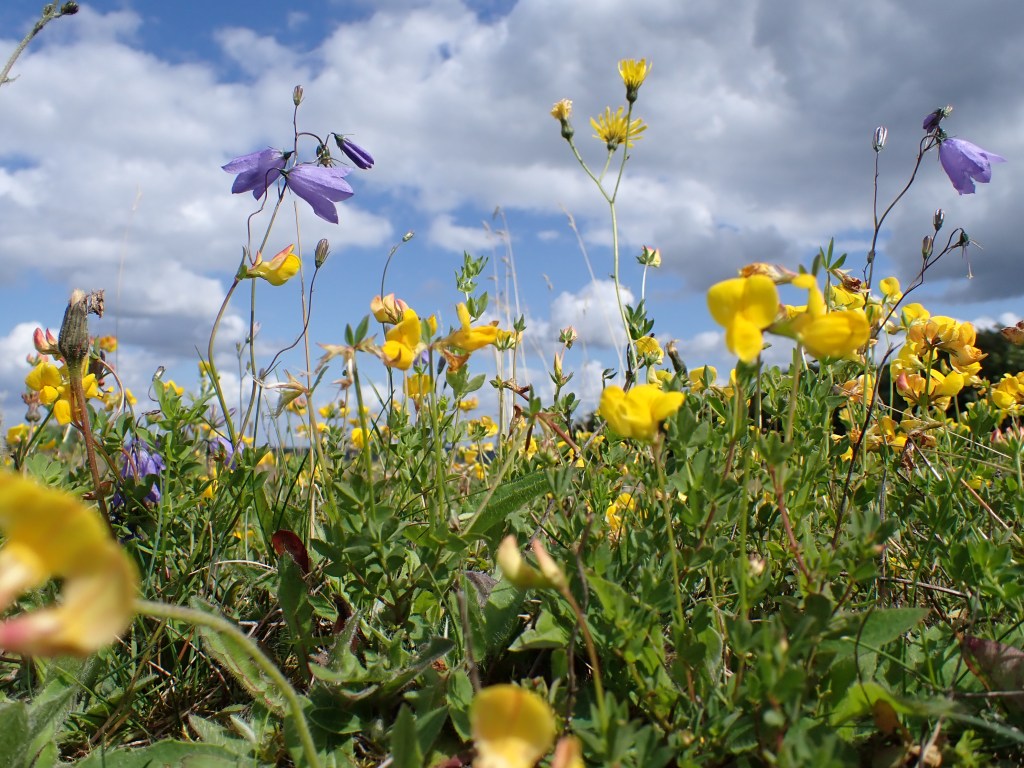
A flower meadow looks complex. It is complex (I’ve written about it here. But more than that. You realise that every single insect and almost every bloom is making hour by hour, minute by minute, adjustments to maximise harvest, or conversely, to enhance reproductive success. It is a kind of chaos of individuals, all pursuing separate agendas, often competing, sometimes practising sneaky, cheating ways to achieve their private goals; yet all, ultimately contribute to the success of the whole.
Flowers and insects are truly part of the bedrock of life on Earth. Every third mouthful we eat is thought to originate in these relationships. If we are truly – as the saying goes – what we eat, then at some level we are insects and plants. This book helps you to see how and why. It also allows you to understand that solitary bees are at the heart of flower-rich ecosystems. After reading this painstaking study they’ve never seemed more interesting. Solitary Bees could only have been written by two authors each of whom has a lifetime of research to enrich their understanding.


Above are two of my favourite recent solitary bee sightings: Spined Mason Bee (left) which just reaches Derbyshire and makes its nest in old snail shells. But looks at the orbs of this Green-eyed Flower Bee, seen at Beachy Head!
 Mark Cocker